
Historical white paper · Open access
Early Civilizations’ Currency
From shells, grain, and weighed metal to the first coins
Money appeared long before coins. This comparative account follows the forms and institutions that made grain, shells, cloth, livestock, weighed metal, and eventually stamped coinage usable as systems of value, measurement, payment, and trust.
Digital Object Identifier 10.5281/zenodo.22296814About the paper
Currency is a system before it is an object.
The paper challenges a simple progression from barter to commodity money to coins. Instead, it shows how different societies combined accepted media with measurement, recordkeeping, authority, and enforceable obligations.
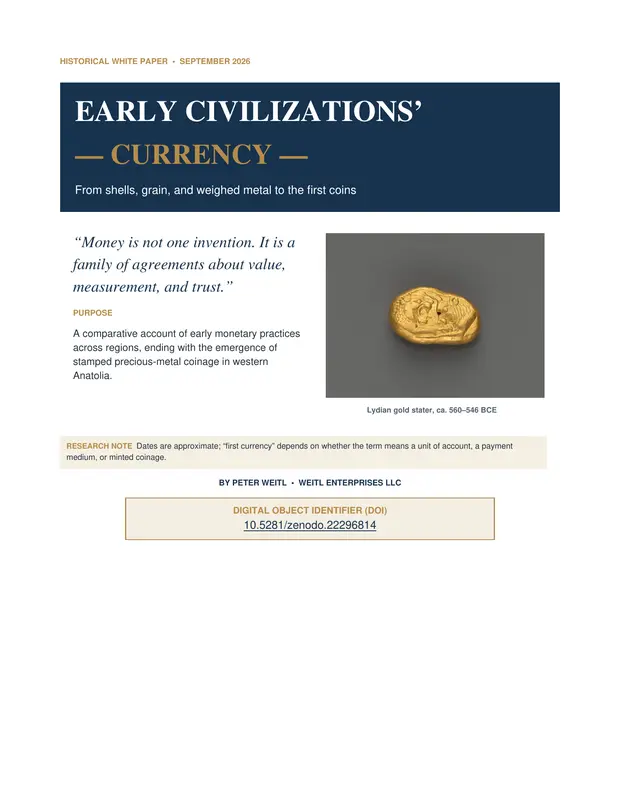
The historical endpoint is western Anatolia in the late seventh century BCE, where Lydia and neighboring Ionian communities pioneered stamped electrum coinage. Under Croesus, separate gold and silver issues created a more controlled bimetallic system.
Cite this paper
Suggested citation
Weitl, P. (2026). Early Civilizations - Currency (Version 1). Zenodo. https://doi.org/10.5281/zenodo.22296814