
Historical white paper
After the Coin
Coinage, Credit, and the Making of Monetary Institutions
Coinage made verification more portable; later monetary arrangements made claims more transferable. This continuation examines coins, paper instruments, merchant networks, and bank accounts as coexisting ways to organize payment and discharge obligations, from early western Anatolian coinage to public banks around 1700.
Digital Object Identifier 10.5281/zenodo.22669797About the paper
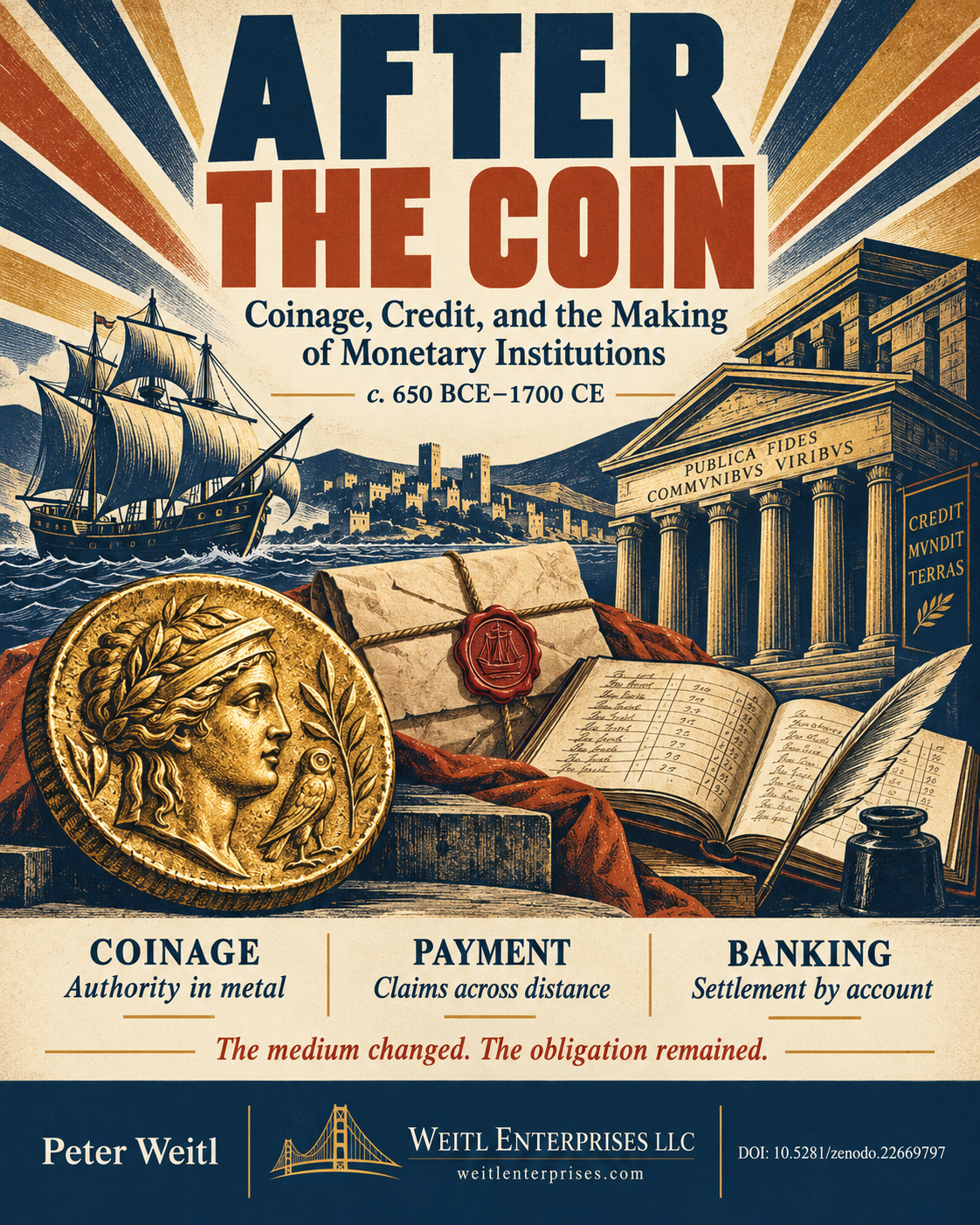
The medium changed. The obligation remained.
Evidence from Athens, imperial coinage, Chinese paper currencies, commercial correspondence, and European banking shows how monetary innovations redistributed uncertainty. Authenticating a coin, transferring a claim, and completing settlement remained distinct institutional tasks.
The paper follows regional differences and reversals rather than a universal progression from metal to paper. Its case studies connect monetary reliability to acceptance rules, documentary evidence, liquidity, and accountability, while examining failures and the social costs of monetary expansion.
Cite this paper
Suggested citation
Weitl, Peter. After the Coin: Coinage, Credit, and the Making of Monetary Institutions. Weitl Enterprises LLC, September 2026. https://doi.org/10.5281/zenodo.22669797